

On this page
It is a sound most parents learn to live with. You walk past your child’s room at night and hear it — the heavy breathing, the snore that cuts off and starts again, or the dry, grating sound of teeth moving against each other. In the morning the sheets are twisted, the pillow is on the floor, and getting your child out of bed takes three attempts.
Most of us file this under personality. A heavy sleeper. A wiggly kid. A grinder, like their father was. And often that is all it is.
But snoring and night-time grinding are also two of the signs that show up when a child is working harder than they should to breathe while asleep. They are worth a second look — not because something is necessarily wrong, but because the window for the simplest kind of help is open while a child is still growing, and it does not stay open forever.
Snoring Is Common in Children. That Does Not Make It Normal.
Adults snore for all sorts of reasons — weight, alcohol, a head cold, sleeping on their back. In children the list is much shorter, and most of it comes down to one thing: how much room there is for air to move through the nose and the back of the throat.
That space is shaped by things that are still forming. The size of the tonsils and adenoids. How well the nose is working. And the shape of the upper jaw, which forms the floor of the nose and the roof of the mouth at the same time. A narrow upper jaw leaves less room for the tongue, and a tongue with nowhere to sit tends to sit further back.
A child who snores occasionally with a cold is doing something ordinary. A child who snores most nights, breathes through their mouth during the day, and wakes up tired is telling you something different.
Why Snoring and Grinding So Often Show Up Together
Parents rarely connect the two. They are treated as separate complaints — one for the pediatrician, one for the dentist. But they frequently share a cause.
When the airway narrows during sleep, the body does not simply accept less air. It responds. Muscle tone changes, the jaw and tongue shift position to open the space back up, and sleep lightens briefly. Repeat that many times a night and you get a child who was technically in bed for ten hours and still wakes up exhausted. Grinding is one of the movements that happens along the way.
Grinding has other causes too, and in adults it is often a different story altogether — we cover that in our guide to teeth grinding treatment. In a child, though, grinding that comes with snoring is worth looking at as one picture rather than two.
The Signs That Tend to Travel Together
No single item on this list means anything on its own. Plenty of healthy children do several of them. What matters is how many cluster together, and whether they persist:
- Snoring most nights, not just with a cold
- Sleeping with the mouth open, or chapped lips most mornings
- Grinding teeth at night
- Restless sleep — twisting, kicking off covers, odd sleeping positions with the head tipped back
- Bedwetting past the age it would be expected to stop
- Dark circles under the eyes
- Waking up tired after a full night in bed
- Trouble focusing, or being described as hyperactive or irritable in the afternoon
- Frequent congestion, or always seeming to have a blocked nose
- Crowded teeth, a high narrow palate, or a bite that does not meet evenly
One or two, in a child who is otherwise thriving, is not a cause for worry. Five or six that have been true for a year is a reason to have someone look.
What a Dentist Notices That Is Hard to See at Home
Part of why this often surfaces at a dental visit is simple: a dentist is looking directly at the roof of the mouth every six months, and changes in shape are easier to spot than changes in sleep.
The shape of the upper arch is one of the first things we look at. A narrow, high, V-shaped palate leaves the tongue less room than a broader, U-shaped one. The difference is not subtle once you see the two side by side.
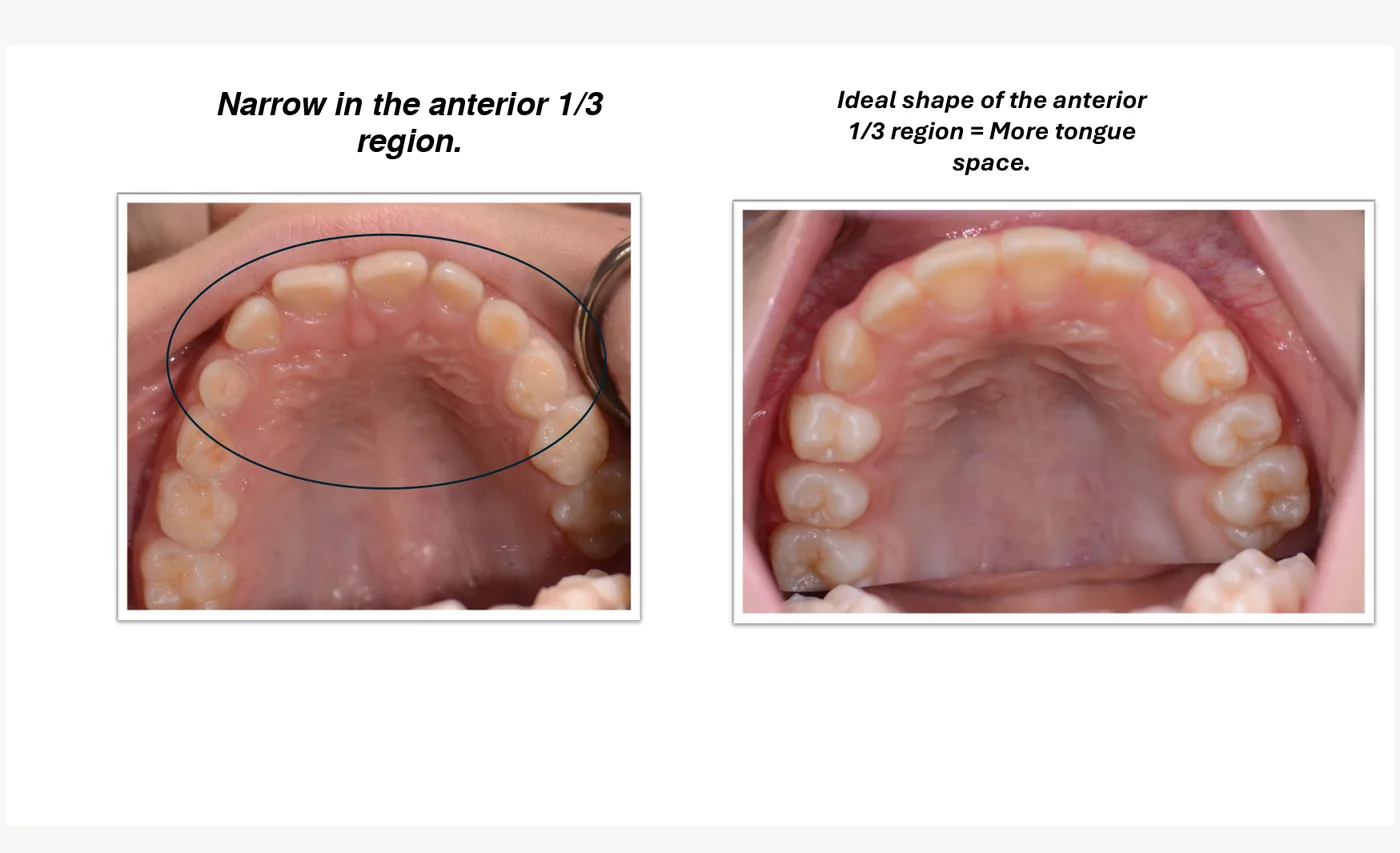
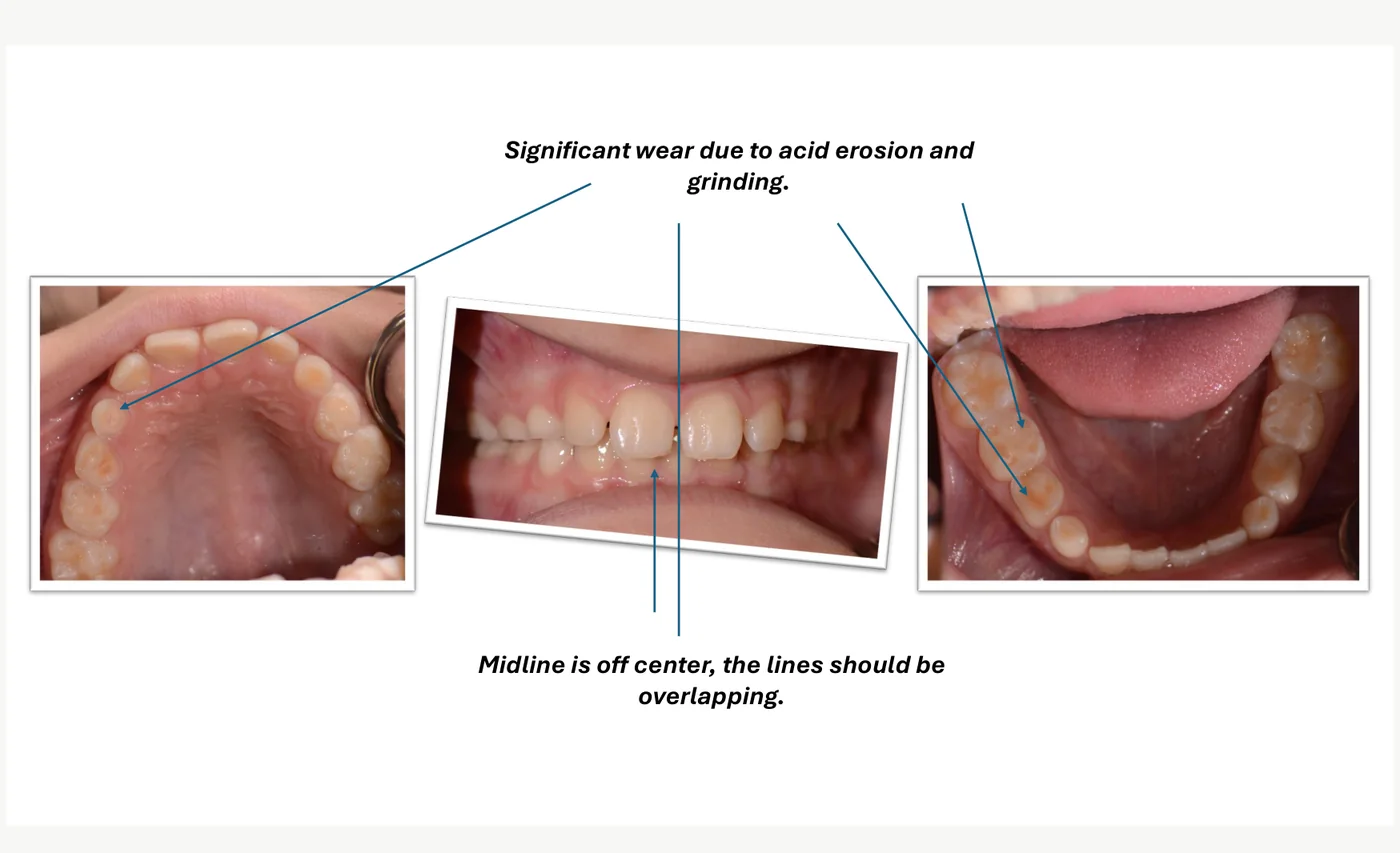
The teeth themselves keep a record too. Night-time grinding flattens the biting edges in a way that is recognizable, and a bite that has drifted off-center often goes with a jaw that has been holding an unusual position. Children do not report any of this, because to them it has always been this way.
There is a side effect worth mentioning here. A child who breathes through their mouth all night has a dry mouth all night, and saliva is what keeps the enamel protected. Mouth breathing is one of the quieter reasons a careful brusher still ends up with decay — which is part of why cavities can develop without any pain at all, and why preventing cavities in children is about more than brushing technique.
Why Age Seven Keeps Coming Up
The American Association of Orthodontists suggests a first orthodontic evaluation around age seven. That number can sound arbitrary, and most parents assume it is about braces. It is not, really.
By seven, enough permanent teeth have arrived to show how the jaws are developing, while the bones themselves are still growing and still responsive. The seam in the roof of the mouth has not fused. Widening a narrow upper jaw at that stage is a slow, gentle process that works with growth rather than against it.
Wait until the mid-teens and the same correction becomes a bigger undertaking. Nothing is lost by having a look at seven and being told everything is fine. Something can be lost by waiting until thirteen to ask.
What Can Actually Be Done
If the upper jaw is narrow, the usual approach is an expander — a small appliance that widens the arch gradually over a few months. Some are removable, some are fixed in place, and the choice depends on the child and on what the arch needs.
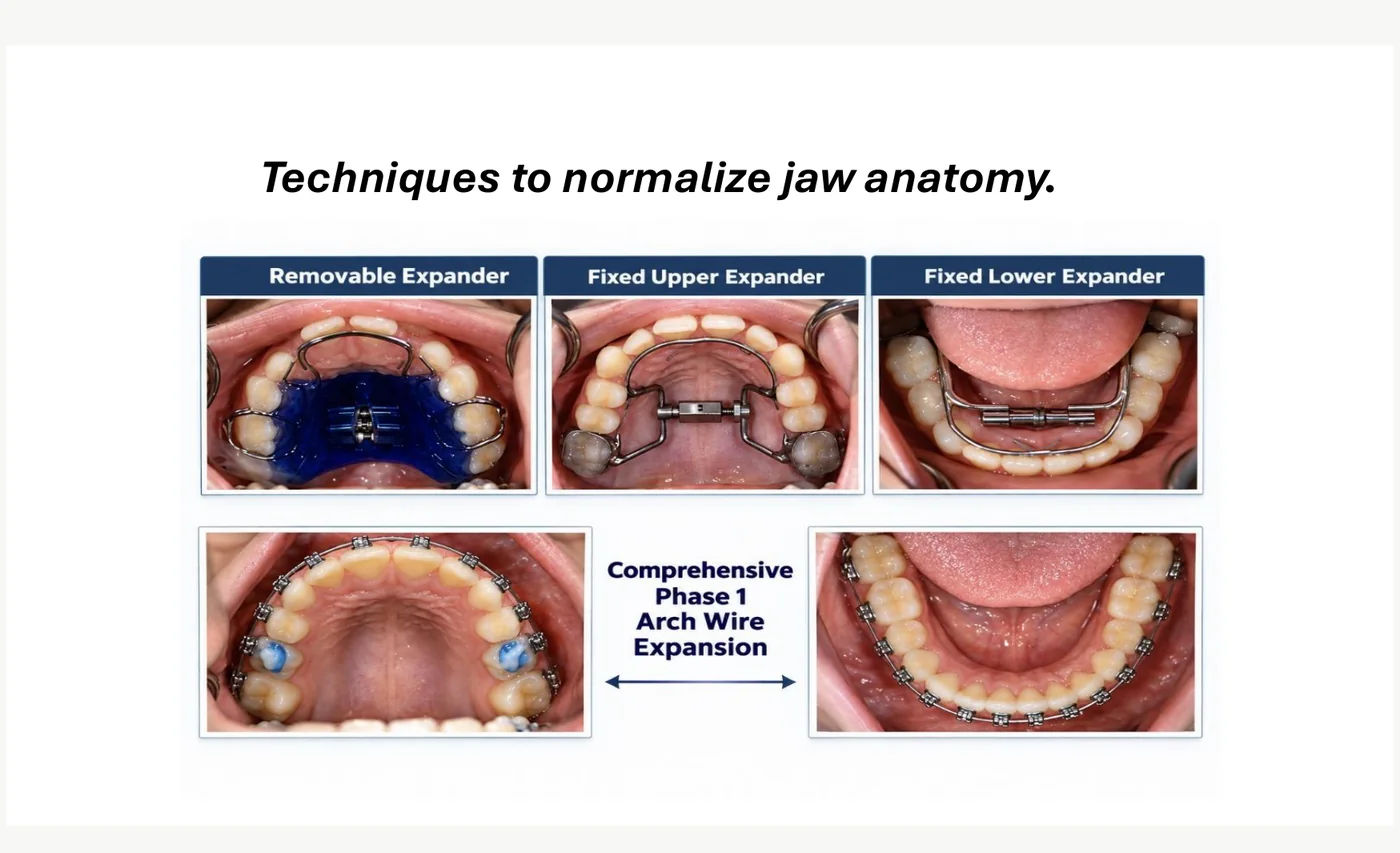
Widening the arch does two things at once. It makes room for teeth that were going to be crowded, which often means less orthodontic work later — and, by the time those teenage years arrive, a simpler decision between clear aligners and braces. It also gives the tongue somewhere to sit.
Not every child needs this, and an expander is not a treatment for sleep problems in its own right. But where a narrow arch is part of the picture, it is one of the few things that is genuinely easier to do early.
What This Is Not
We want to be clear about the limits here, because this is an area where confident claims get made that should not be.
A dentist does not diagnose sleep apnea. That diagnosis comes from a physician, usually after a sleep study, and when the signs point that way the right next step is a referral — often to an ENT, since enlarged tonsils and adenoids are a common cause in children and sit outside dental treatment entirely.
What a dental visit can do is notice the pattern, examine the structures we are qualified to examine, and make sure the right person sees your child next. Quite often the answer is reassurance. Sometimes it is a referral. Sometimes it is widening an arch that was always going to need widening.
Questions Parents Ask
Is it bad for a child to grind their teeth at night?
Occasional grinding in a young child is common and often outgrown. What is worth examining is grinding that continues, grinding that has visibly worn the teeth down, or grinding that comes alongside snoring, mouth breathing and daytime tiredness. The grinding itself is usually not the problem — it is a signal worth reading.
My child snores but sleeps all night. Should I still be concerned?
Staying in bed all night and sleeping well are not the same thing. Children with disrupted sleep often do not wake fully; sleep simply lightens and deepens repeatedly. The more telling question is how your child is during the day — whether they wake rested, and whether afternoons are a struggle.
Will my child grow out of mouth breathing?
Sometimes, particularly if the cause was temporary, such as allergies or enlarged tonsils that shrink with age. But habitual mouth breathing also influences how the face and jaws develop while that development is still happening, so it is not something to simply wait out without having the cause identified.
Does an expander hurt?
Most children describe pressure rather than pain, strongest in the first few days and after each adjustment. Speech and eating feel strange for about a week. Children adapt to expanders considerably faster than their parents expect.
At what age should my child be evaluated?
Around seven for a general orthodontic evaluation. Earlier if the signs above are clearly clustering — there is no minimum age for someone to look at a child who snores every night and wakes up exhausted.
What happens at the first visit?
A conversation about sleep and breathing, an examination of the arches, bite and tongue space, and imaging where it is warranted. You leave knowing whether anything needs doing, and if so, what and when. If your child has not seen a dentist before, our guide to the first visit to a family dentist covers what to expect.
If any of this sounds like your child, our page on children’s airway and early orthodontics goes through the signs, the examination and the treatment options in more detail. Or call us at (561) 429-2196 to arrange an evaluation with Dr. Babak Robert Etemad at our West Palm Beach practice.
