Children’s airway & early orthodontics

Children’s Airway Health and Early Orthodontic Treatment in West Palm Beach

If your child snores, grinds their teeth, or sleeps with their mouth open, the cause is often how they are breathing — not how tired they are. We look at the shape of the upper jaw, the bite and the airway together, and treat early while the jaw is still growing.

What we look at during an evaluation

An airway-focused examination looks past the teeth themselves to the structures around them — how wide the upper jaw is, how the bite meets, and how much room there is to breathe.

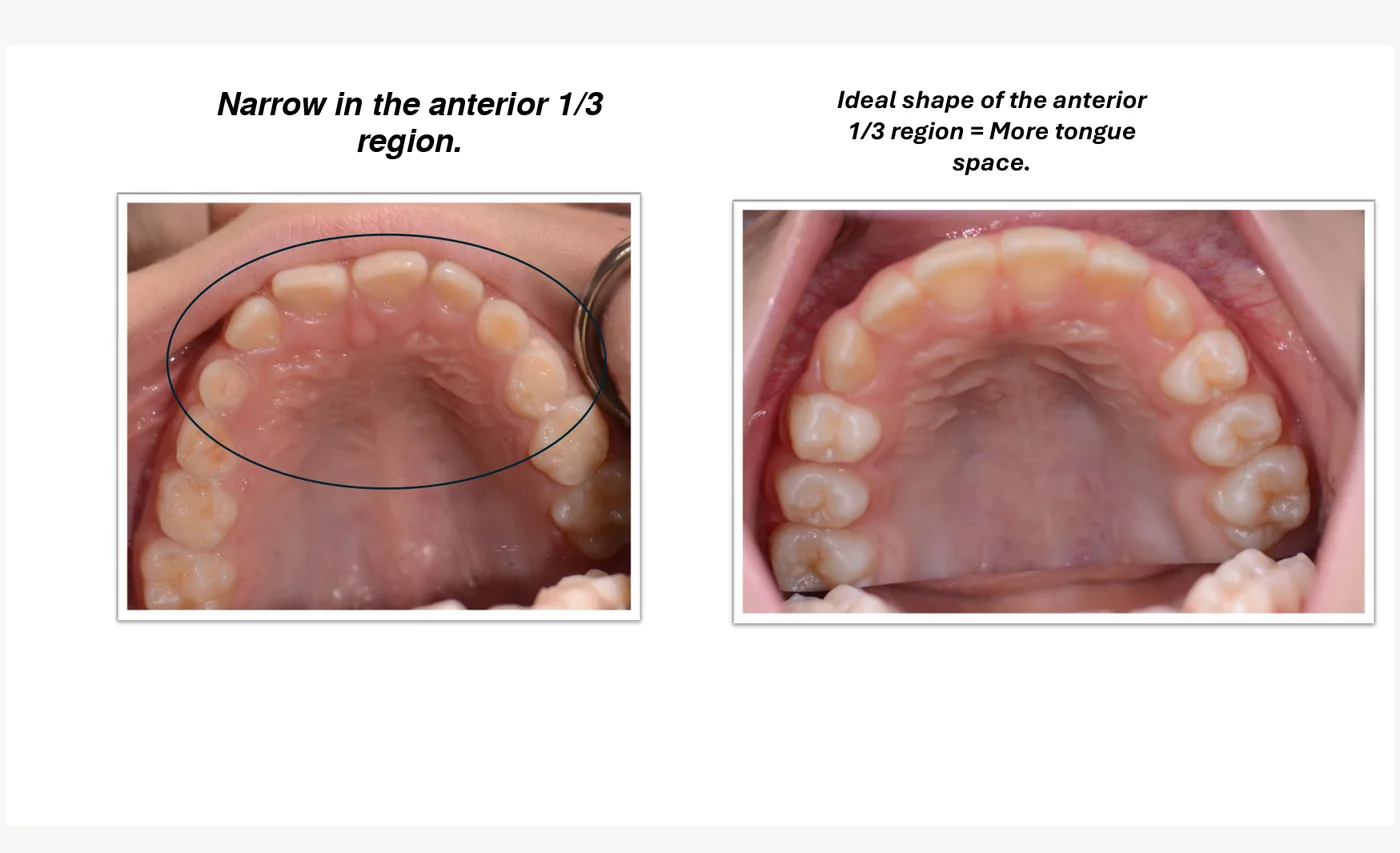
Upper arch shape and tongue space

The roof of the mouth is also the floor of the nose. A narrow upper arch leaves less room for the tongue to rest where it should — up against the palate — and less volume above it for air to pass through the nose.

We compare the width across the front third of the arch against the shape we would expect for your child’s age.

Comparison of a narrow upper dental arch and an ideal arch shape with more tongue space
A narrow anterior arch, left, compared with an arch shape that leaves more tongue space.

Tooth wear and bite alignment

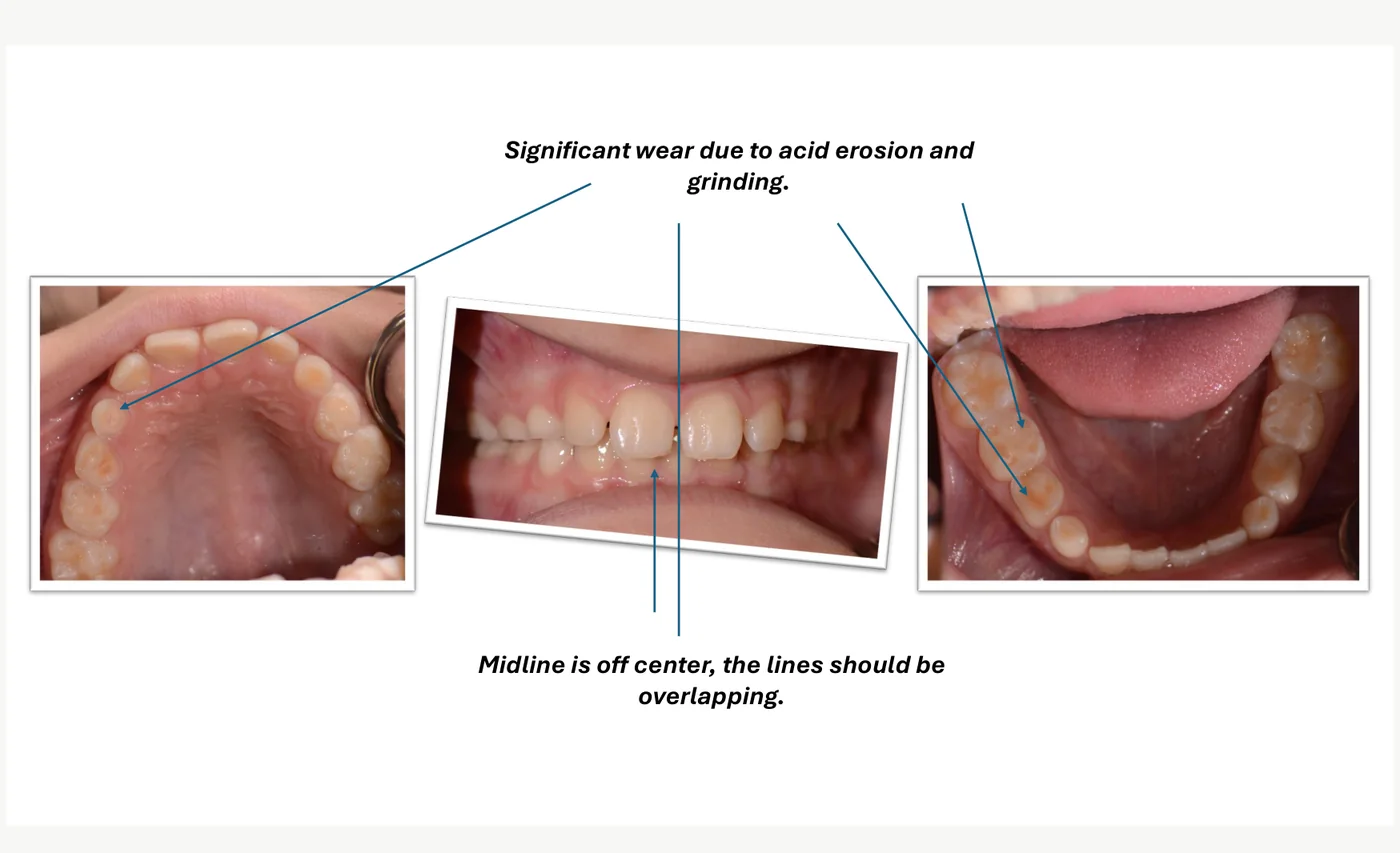
Worn edges on young teeth are a clue, not just a cosmetic problem. Grinding and acid erosion often travel with disrupted sleep, and a midline that sits off center points to the jaws meeting unevenly.

Clinical photographs showing tooth wear from grinding and acid erosion and an off-center dental midline
Wear from grinding and erosion, and a midline that does not line up.

How the upper and lower jaws relate

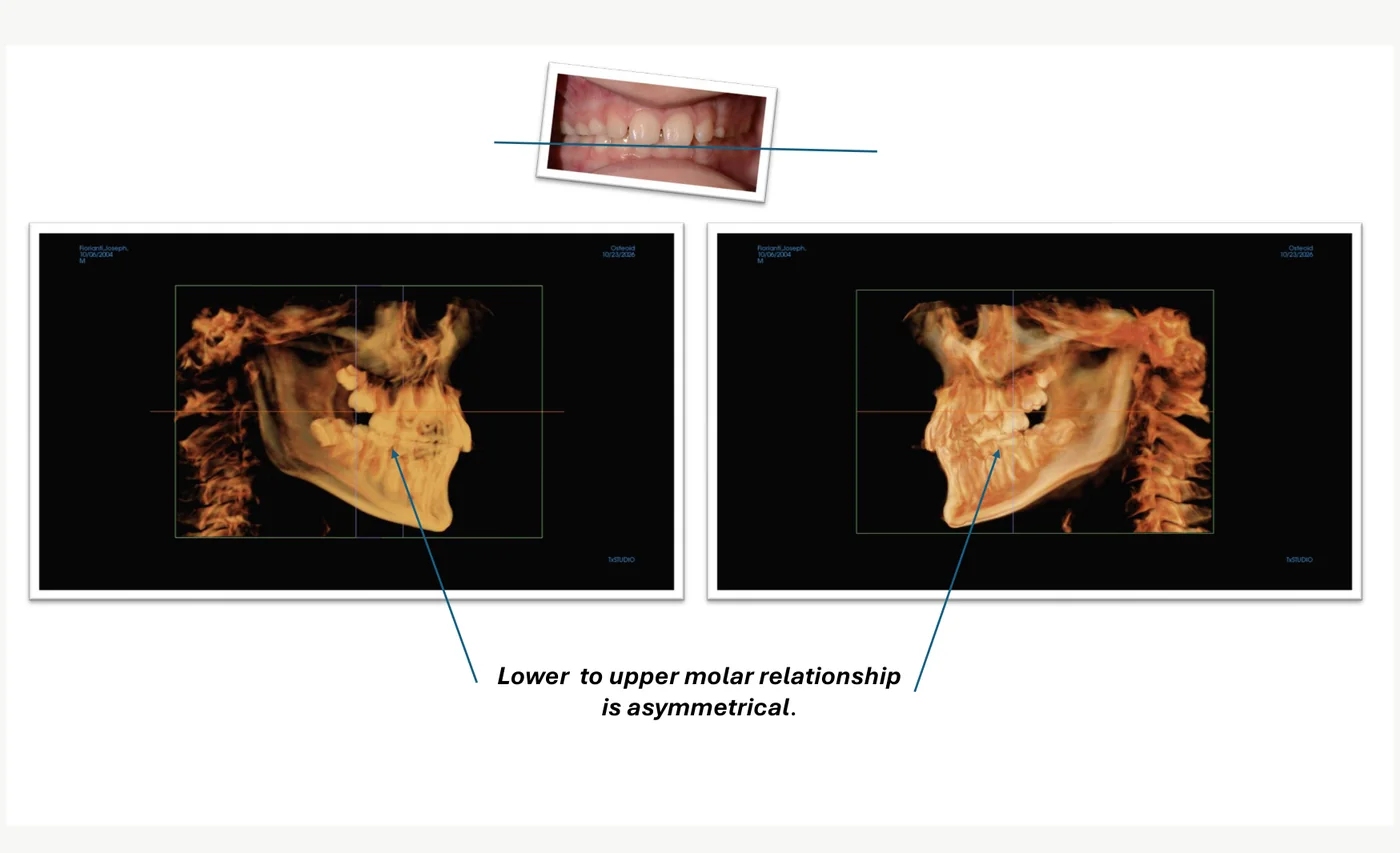
We check whether the lower jaw sits symmetrically against the upper one. An asymmetric molar relationship changes where the lower jaw — and with it the tongue — comes to rest, which in turn affects the space behind it.

Three-dimensional scan views used to assess the upper and lower jaw relationship in a child
Assessing the relationship between the upper and lower jaw.

Airway imaging with 3D CBCT

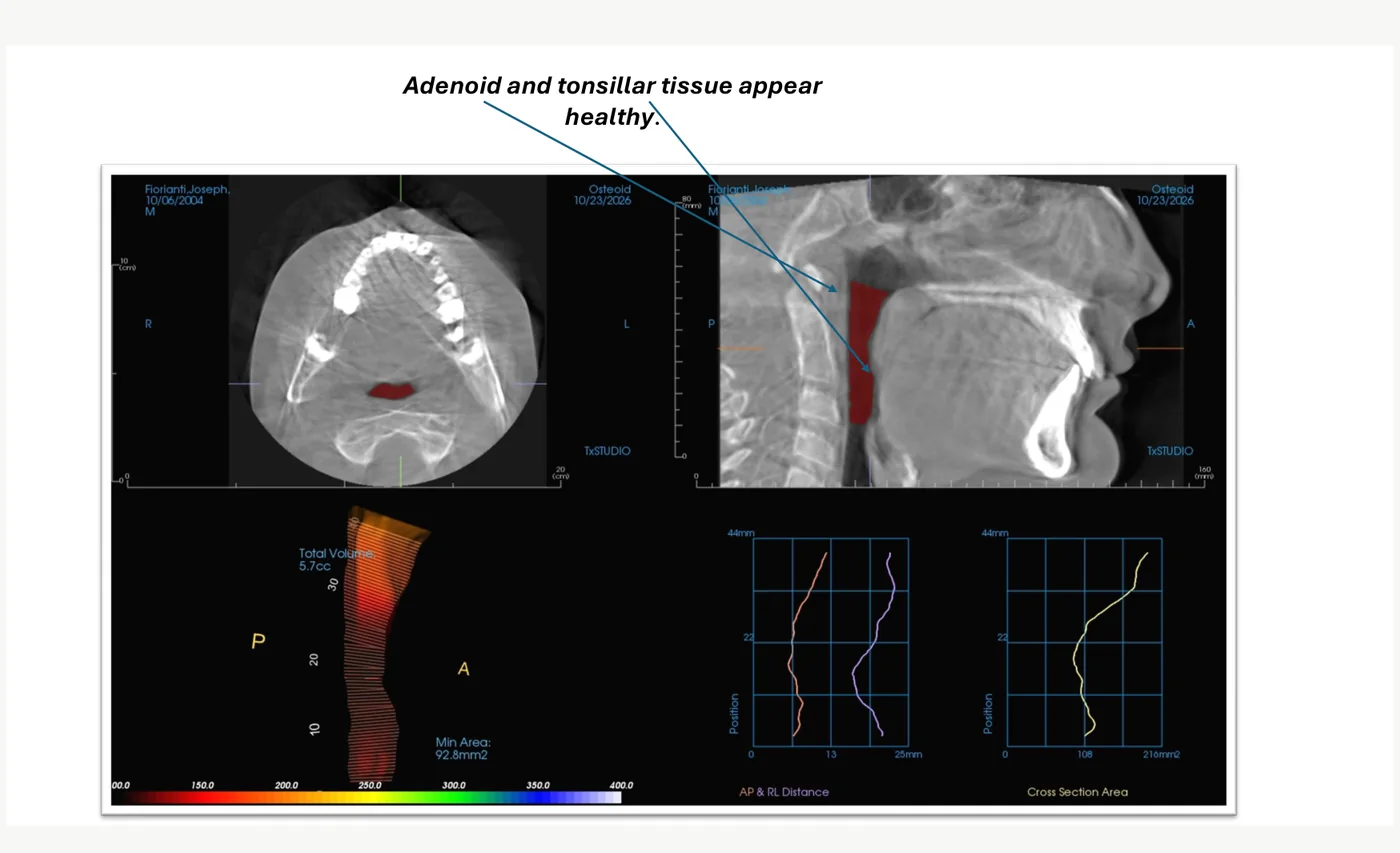
Our in-office 3D cone-beam scanner lets us see the airway itself rather than infer it — its narrowest point, its cross-sectional area, and whether the adenoid and tonsillar tissue looks healthy or crowded.

Imaging is taken only when there is a clinical reason for it, and the findings are explained to you on screen.

3D cone-beam CT views used to evaluate a child's airway, adenoid and tonsillar tissue
CBCT views used during a clinical airway evaluation.

Early orthodontic treatment: what it involves

Early treatment, often called Phase 1 or interceptive orthodontics, is not the same as braces. The aim is to guide the jaw while it is still developing, rather than straighten teeth that have finished moving.

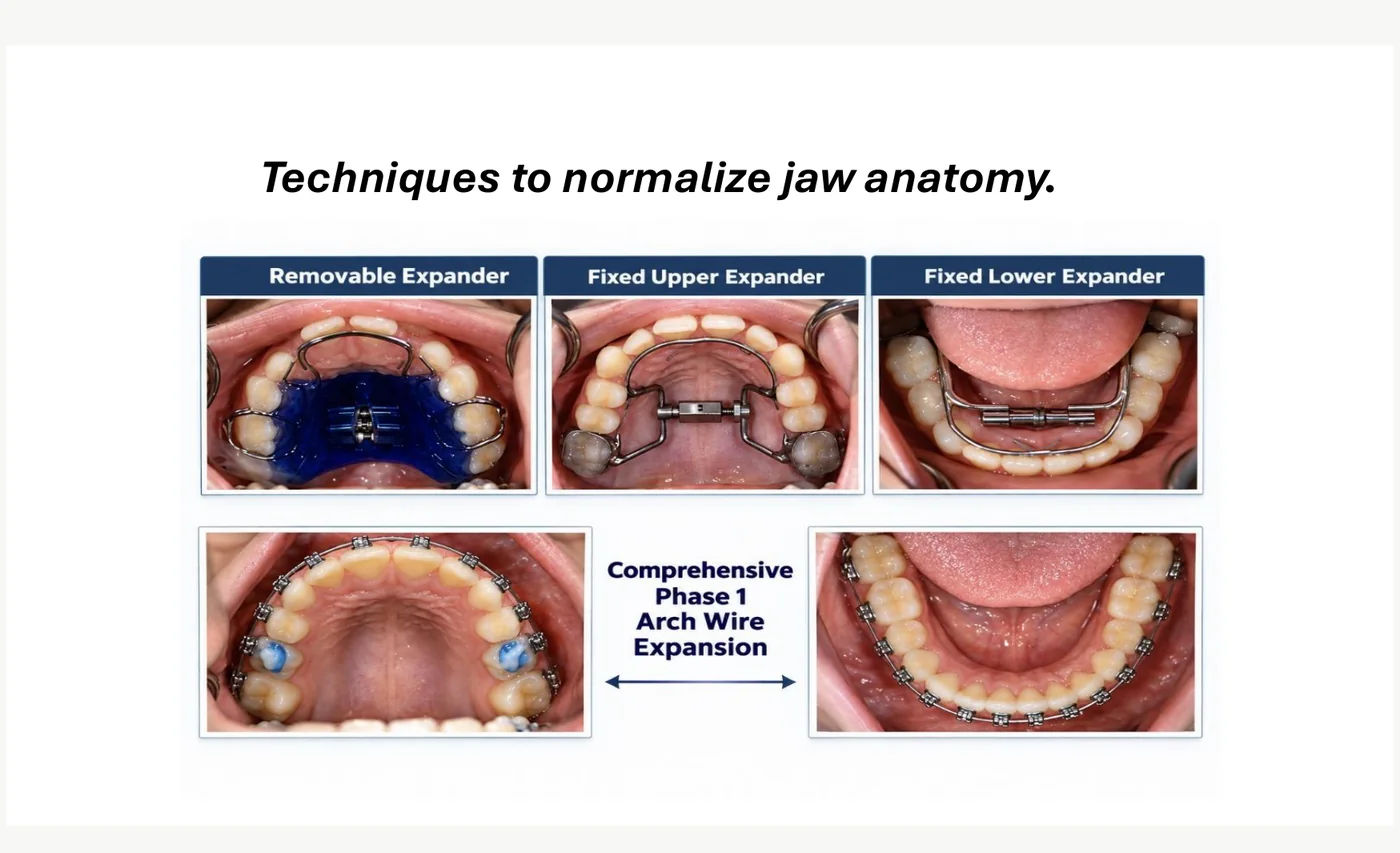
Most of this work is done with expanders, which widen the upper jaw gradually over weeks. Which one suits your child depends on their age, their bite and how much width is needed.

Removable expander, fixed upper expander, fixed lower expander and comprehensive Phase 1 arch wire expansion appliances
Appliances used to widen the arch: removable and fixed expanders, and comprehensive Phase 1 arch wire expansion.

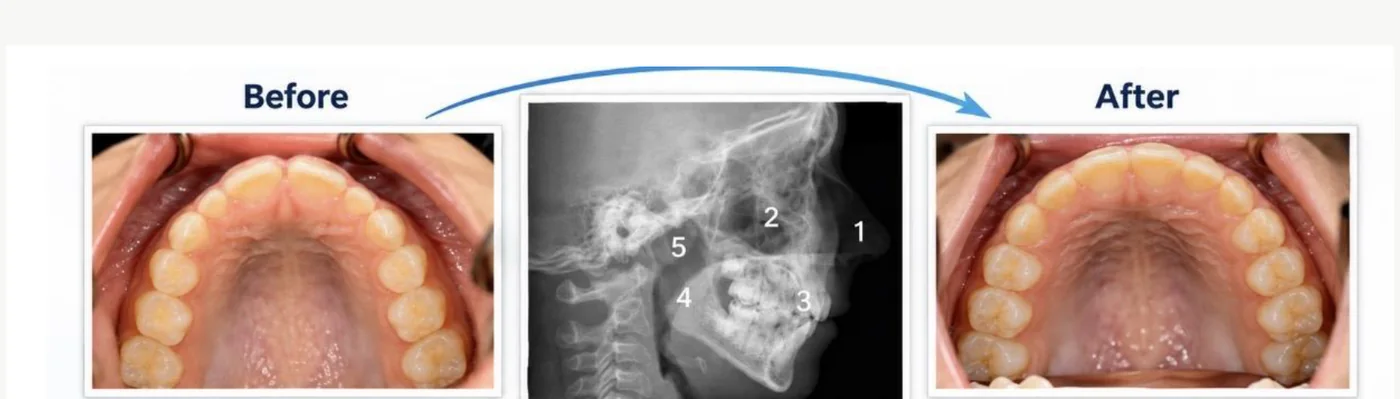
What widening the upper arch changes

Because the palate forms the floor of the nose, widening it does more than make room for teeth.

Before and after photographs of a child's upper dental arch following maxillary expansion, with a cephalometric x-ray
A child’s upper arch before and after maxillary arch development.
  1. Nasal diameter increases, so there is more room for air to pass through the nose.
  2. Pressure behind the nose falls as the volume of that space increases.
  3. The premaxilla advances, bringing the front of the upper jaw forward.
  4. The lower jaw and tongue can come forward, and as the upper arch widens the soft palate drops, improving the space behind the tongue.
  5. Nasal breathing is easier to re-establish, which supports the adenoid tissue and tonsils settling back toward normal.

Signs your child may be struggling to breathe

Children rarely complain about poor sleep. Instead it shows up in their nights, their behavior and their teeth. Any one of these on its own may mean nothing. Several together are worth an evaluation.

SnoringRegular snoring in a child is not normal, however settled they seem.
Mouth breathingSleeping or resting with the lips apart, often with dry lips in the morning.
Grinding teethNight-time grinding that wears the enamel down early.
Restless sleep and nightmaresTossing, odd sleeping positions, waking frequently, frightening dreams.
Bed wettingContinuing past the age you would expect it to have stopped.
Difficulty settling or concentratingDaytime irritability and trouble focusing have been linked to broken sleep.
Repeated ear infectionsA pattern of ear trouble alongside the other signs.
Frequent upper airway infectionsRecurring congestion, colds and blocked noses.
Dark circles or a long, tired faceA tired look that does not change with an early bedtime.

Why breathing affects how a child sleeps

You do not need to stop breathing for sleep to suffer. When the airway is narrow, a child has to pull harder to draw each breath. That extra effort creates negative pressure in the airway, and the brain reacts to it.

This pattern is often described as upper airway resistance. It is more common in children and women than the heavy snoring most people picture, and it can be present without snoring and without sleep apnea.

  1. Extra effort to breathe. A narrow airway means more negative pressure with every breath.
  2. The brain registers the strain. It responds as though to a threat, through the sympathetic nervous system.
  3. Adrenaline and cortisol rise. The body shifts out of settled, restorative sleep.
  4. Sleep fragments. The result can be broken sleep, silent acid reflux and night-time grinding — the very signs parents notice.

Snoring in children can also be a sign of obstructive sleep apnea, which is a medical diagnosis. We do not diagnose sleep apnea. Where the picture suggests it, we will say so and help you arrange assessment with your child’s physician, an ENT or a sleep specialist.

When should a child be evaluated?

The American Association of Orthodontists recommends a first orthodontic evaluation by age 7. By then the first permanent molars and incisors are usually through, which is enough to tell whether the jaws are developing evenly.

Airway signs are worth raising earlier than that. If your child snores most nights, breathes through their mouth, or grinds their teeth, there is no reason to wait for a birthday — an examination costs nothing but an appointment, and the jaw is easiest to guide while it is still growing.

If your child is anxious about dental visits, our approach to comfortable, anxiety-free care applies to children too.

Questions parents ask

At what age should my child be evaluated?

By age 7, following the American Association of Orthodontists’ recommendation. If your child snores, mouth breathes or grinds their teeth, raise it at their next check-up whatever their age.

Does snoring always mean sleep apnea?

No. Many children who snore do not have sleep apnea, and some children with disrupted sleep do not snore at all. Sleep apnea is a medical diagnosis made by a physician, usually after a sleep study. Our role is the dental and skeletal side — the shape of the jaw and the space available — and to tell you when a medical opinion is warranted.

Is an expander painful?

It is not usually described as painful. Children typically report pressure for a short period after each adjustment, and most adapt to speaking and eating within a few days.

How long does early treatment take?

It varies with the child and the amount of width needed. Active expansion is often a matter of weeks, followed by a period of holding the new width while bone fills in. We give you a timeline for your child’s case once we have examined them.

Will my child still need braces later?

Possibly. Early treatment addresses jaw development and the airway; it does not replace later alignment of the permanent teeth. What it often does is make that later stage simpler, and reduce the chance that teeth have to be removed to create space.

Who will see my child?

Dr. Babak Robert Etemad, DMD is a general dentist who has practiced in West Palm Beach since 2007. Where a case calls for a specialist’s involvement, he will tell you and coordinate the referral. You can read more about his training.

Ask us about an airway and orthodontic evaluation

If something about your child’s sleep or breathing has been bothering you, bring it up. An evaluation will tell you whether there is anything to act on.

Palm Beach Institute of Dentistry · 3472 Forest Hill Blvd, Suite 2A, West Palm Beach, FL 33406 · (561) 429-2196

The clinical images on this page are examples from treated cases, shown for education. Symptoms and imaging do not establish a diagnosis, and treatment depends on an individual clinical assessment. See our dental FAQ or new patient information.

Xray Free Offer Exam — Palm Beach Institute of Dentistry
Palm Beach Institute Of Dentistry
Privacy Overview

This website uses cookies so that we can provide you with the best user experience possible. Cookie information is stored in your browser and performs functions such as recognising you when you return to our website and helping our team to understand which sections of the website you find most interesting and useful.