 palmbeachinstituteofdentistry
Comments Off on Same Day Dental Crown vs Filling: Which Is Better?
palmbeachinstituteofdentistry
Comments Off on Same Day Dental Crown vs Filling: Which Is Better? By Dr. Robert Etemad, Palm Beach Institute of Dentistry
When a tooth needs repair, deciding between a same-day crown and a filling matters for both function and long-term health. Knowing how these options differ will help you pick the treatment that fits your tooth’s condition and your lifestyle. This article breaks down what each restoration is, the benefits and trade-offs, typical costs, and what recovery looks like so you can choose with confidence.
Restorations protect your teeth and preserve your bite. Fillings and same-day crowns serve different needs: fillings repair smaller areas of decay, while crowns are used when a tooth is extensively damaged or weakened. Understanding these differences will make it easier to weigh durability, appearance, and cost when planning treatment.
For personalized guidance, the Palm Beach Institute of Dentistry provides both same-day crowns and fillings. Our team will review your options and recommend the approach that best fits your oral health and goals.
Fillings restore a tooth after decay is removed. Modern fillings—most commonly composite resin or, in some cases, silver amalgam—are shaped to match your tooth and restore chewing surface and function. They’re usually less invasive than crowns and can often be completed in a single visit.
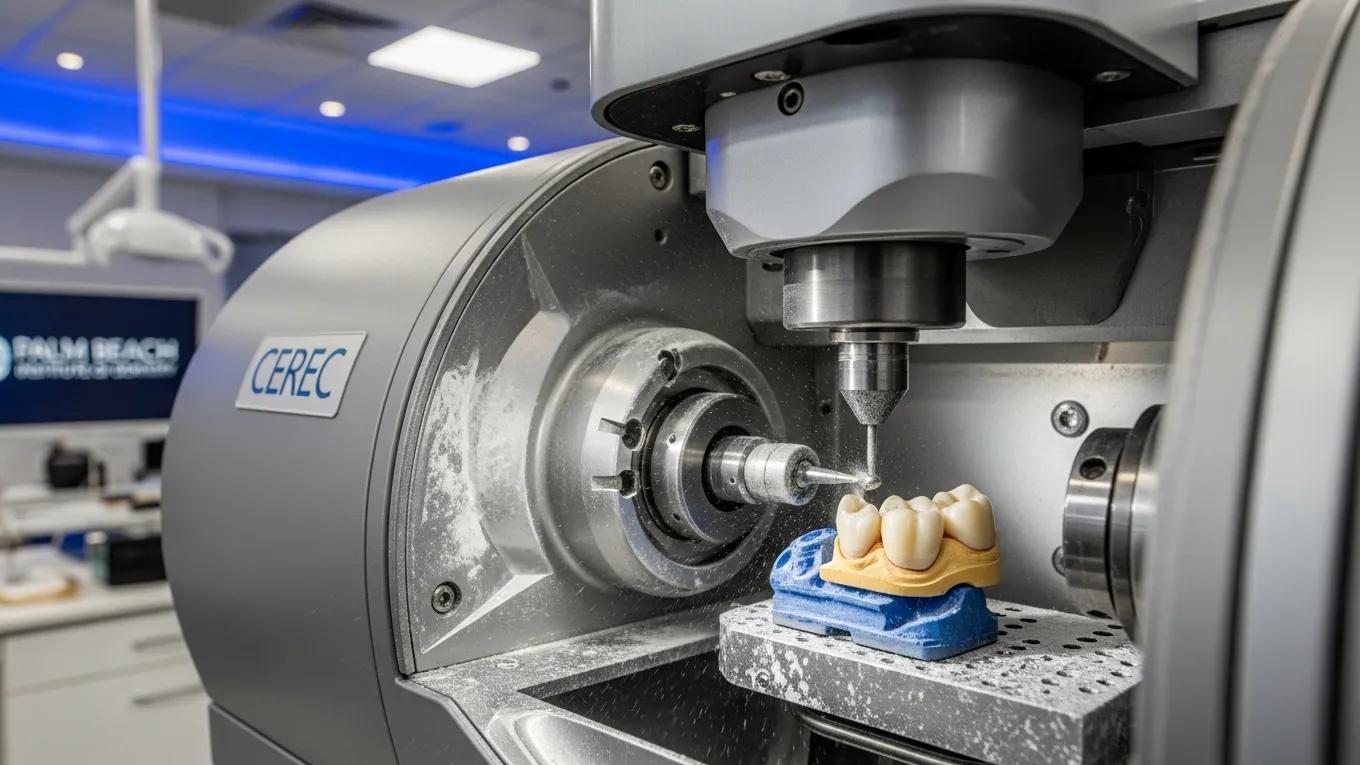
Same-day crowns—often made with CEREC or similar CAD/CAM technology—allow your dentist to design, mill, and place a ceramic crown in one visit. This eliminates temporary restorations and multiple appointments while delivering a strong, natural-looking result.
Materials like modern zirconia are increasingly used in single-visit dentistry. Ongoing research evaluates their fit, wear against opposing teeth, and fracture resistance to ensure reliable performance.
Zirconia Crowns for Single-Visit Dentistry: Performance Analysis
This study evaluated the intaglio surface trueness, wear of the opposing tooth, and fracture resistance of full-contour zirconia crowns made from different formulations—fully-sintered FSZ and high-speed sintered 4YZ/5YZ. The research assessed fit, antagonist wear volume, and fracture resistance under simulated conditions for single-visit monolithic zirconia crowns. — HI Yoon, 2022
Several important differences can influence which restoration is best for you—especially durability, cost, and how much of the natural tooth needs to be removed.
Clinical literature highlights these distinctions and shows that the choice between direct restorations (like fillings) and indirect restorations (like crowns) depends on the amount of remaining tooth structure and the restoration’s expected performance.
Crowns vs. Fillings: Durability, Cost, and Material Choice
Direct restorations (for example, composite or amalgam) are placed directly into the prepared tooth. Indirect restorations, such as cast metal or ceramic crowns, are fabricated outside the mouth and then fitted. The restoration selected depends on how much tooth remains and may affect long-term durability and cost. Decisions about additional procedures, like posts and cores, are clinician-driven. Comparative performance for root-filled teeth between crowns and conventional fillings remains uncertain. — P Sequeira-Byron, 2015
Both restorations restore chewing function and tooth appearance but in different ways. Fillings replace lost tooth structure inside the cavity, while crowns cover the entire visible portion of the tooth, offering added strength and a uniform appearance—especially useful when a tooth is weakened or fractured.
Material choice affects longevity, look, and cost. Common filling materials include:
Crown materials commonly include:
You’ll often choose a crown when the tooth needs more than a simple repair. Crowns are typically recommended for:
The extent of decay or structural loss guides the decision. Small cavities are usually well-managed with fillings. When a tooth is structurally compromised or at higher risk of breaking, a crown provides better protection and a more predictable long-term result.
Cost and longevity are key factors in choosing a restoration. Below is a general range to help you plan, though final prices vary by material choice and treatment complexity.
This comparison highlights the typical price and lifespan differences so you can weigh upfront cost against potential long-term value.
Same-day crowns usually cost more than fillings because of the specialized materials and in-office CAD/CAM fabrication. For significant damage, the added expense may be justified by the crown’s durability and protection.
Longevity depends on materials and oral care. Fillings often last 5–10 years, while same-day crowns commonly last 10–15 years with good hygiene and routine dental visits. Regular check-ups help catch wear or issues early.

Recovery varies by procedure but both treatments are generally well tolerated.
Patients often worry about discomfort and appointment length. Fillings are faster and less invasive, so they usually involve shorter visits. Crowns take longer but solve larger problems and reduce the chance of future repairs—trading a longer appointment for more durable results.
We prioritize comfort throughout your treatment. Our approach includes:
By focusing on personalized care and clear communication, the Palm Beach Institute of Dentistry aims to make every restorative treatment as comfortable and effective as possible.
palmbeachinstituteofdentistry
Comments Off on Same Day Dental Crown vs Filling: Which Is Better? By Dr. Robert Etemad, Palm Beach Institute of Dentistry
When a tooth needs repair, deciding between a same-day crown and a filling matters for both function and long-term health. Knowing how these options differ will help you pick the treatment that fits your tooth’s condition and your lifestyle. This article breaks down what each restoration is, the benefits and trade-offs, typical costs, and what recovery looks like so you can choose with confidence.
Restorations protect your teeth and preserve your bite. Fillings and same-day crowns serve different needs: fillings repair smaller areas of decay, while crowns are used when a tooth is extensively damaged or weakened. Understanding these differences will make it easier to weigh durability, appearance, and cost when planning treatment.
For personalized guidance, the Palm Beach Institute of Dentistry provides both same-day crowns and fillings. Our team will review your options and recommend the approach that best fits your oral health and goals.
Fillings restore a tooth after decay is removed. Modern fillings—most commonly composite resin or, in some cases, silver amalgam—are shaped to match your tooth and restore chewing surface and function. They’re usually less invasive than crowns and can often be completed in a single visit.
Same-day crowns—often made with CEREC or similar CAD/CAM technology—allow your dentist to design, mill, and place a ceramic crown in one visit. This eliminates temporary restorations and multiple appointments while delivering a strong, natural-looking result.
Materials like modern zirconia are increasingly used in single-visit dentistry. Ongoing research evaluates their fit, wear against opposing teeth, and fracture resistance to ensure reliable performance.
Zirconia Crowns for Single-Visit Dentistry: Performance Analysis
This study evaluated the intaglio surface trueness, wear of the opposing tooth, and fracture resistance of full-contour zirconia crowns made from different formulations—fully-sintered FSZ and high-speed sintered 4YZ/5YZ. The research assessed fit, antagonist wear volume, and fracture resistance under simulated conditions for single-visit monolithic zirconia crowns. — HI Yoon, 2022
Several important differences can influence which restoration is best for you—especially durability, cost, and how much of the natural tooth needs to be removed.
Clinical literature highlights these distinctions and shows that the choice between direct restorations (like fillings) and indirect restorations (like crowns) depends on the amount of remaining tooth structure and the restoration’s expected performance.
Crowns vs. Fillings: Durability, Cost, and Material Choice
Direct restorations (for example, composite or amalgam) are placed directly into the prepared tooth. Indirect restorations, such as cast metal or ceramic crowns, are fabricated outside the mouth and then fitted. The restoration selected depends on how much tooth remains and may affect long-term durability and cost. Decisions about additional procedures, like posts and cores, are clinician-driven. Comparative performance for root-filled teeth between crowns and conventional fillings remains uncertain. — P Sequeira-Byron, 2015
Both restorations restore chewing function and tooth appearance but in different ways. Fillings replace lost tooth structure inside the cavity, while crowns cover the entire visible portion of the tooth, offering added strength and a uniform appearance—especially useful when a tooth is weakened or fractured.
Material choice affects longevity, look, and cost. Common filling materials include:
Crown materials commonly include:
You’ll often choose a crown when the tooth needs more than a simple repair. Crowns are typically recommended for:
The extent of decay or structural loss guides the decision. Small cavities are usually well-managed with fillings. When a tooth is structurally compromised or at higher risk of breaking, a crown provides better protection and a more predictable long-term result.
Cost and longevity are key factors in choosing a restoration. Below is a general range to help you plan, though final prices vary by material choice and treatment complexity.
This comparison highlights the typical price and lifespan differences so you can weigh upfront cost against potential long-term value.
Same-day crowns usually cost more than fillings because of the specialized materials and in-office CAD/CAM fabrication. For significant damage, the added expense may be justified by the crown’s durability and protection.
Longevity depends on materials and oral care. Fillings often last 5–10 years, while same-day crowns commonly last 10–15 years with good hygiene and routine dental visits. Regular check-ups help catch wear or issues early.
Recovery varies by procedure but both treatments are generally well tolerated.
Patients often worry about discomfort and appointment length. Fillings are faster and less invasive, so they usually involve shorter visits. Crowns take longer but solve larger problems and reduce the chance of future repairs—trading a longer appointment for more durable results.
We prioritize comfort throughout your treatment. Our approach includes:
By focusing on personalized care and clear communication, the Palm Beach Institute of Dentistry aims to make every restorative treatment as comfortable and effective as possible.